Same Day Delivery in Delhi 9350849407 T&C
M

IGNOU BCHET-147 Organometallics, Bioinorganic Chemistry, Polynuclear Hyderocarbons and UV, IR Spectroscopy - IGNOU Solved Assignment (Latest)

Sale!
1st Choice of IGNOU Students to Score High in IGNOU Exam
[ai_sample_generator]
SKU: N/A Categories: ,

PLEASE MATCH YOUR ASSIGNMENT QUESTIONS ACCORDING TO YOUR SESSION

IGNOU BCHET-147 (January 2025 – December 2025) Assignment Questions
PART A: ORGANOMETALLICS, BIOINORGANIC CHEMISTRY
1 Give the IUPAC nomenclature of potassium dichromate. Also give its reaction with potassium iodide in acidic medium.
2 Give the structure of methyl lethium.
3 With the help of suitable equations, give any two methods for preparation of metal carbonyls by reductive carbonylation.
4 Explain the structure of Fe(CO)5 based on valence bond approach.
5 With suitable reactions (any two) explain how carbonyl hydrides are formed by reaction of metal carbonyls with hydrogen.
6 With suitable diagrams explain the polarity of the free CO molecule as well as when it binds with a transition metal cation.
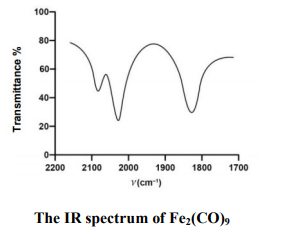
7 What information is obtained from the IR spectrum of Fe2(CO)9?
8 Give a short account of the essential and non essential elements occurring in biological systems.
9 Give the different ways by which lead affects the human body.
10 Explain the conversion of heme to hemin along with a suitable diagram.
PART B: POLYNUCLEAR HYDROCARBONS AND UV, IR SPECTROSCOPY
11 How will you prepare pentan-2-one from ethyl 3-oxobutanoate. Give the reactions involved.
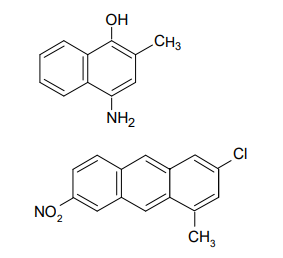
12 (a) Give IUPAC name the following compounds.
(b) Is anthracene aromatic compound? Explain.
13 (a) Among pyridine and pyrrole which one is more basic? Explain
14 In pyridine substitution occur which at the 3 position. Explain.
15 Which are the two main parameters on which the absorption bands in ultraviolet and visible spectra are measured?
16 Explain Woodward rules for predicting -* absorption in dienes.
17 Explain with the help of a diagram the orbital energy relationship between isolated and conjugated C=C and C=O groups.
18 For polyatomic molecule, what are the different types of normal modes of vibration? Give the normal modes of vibrations for the symmetric stretching of a triatomic linear and triatomic angular molecule with suitable diagrams.
19 Give the characteristic frequencies of the ketones and aldehydes. How are they different from esters?
20 (a) List the factors affecting the position and intensity of IR bonds in the IR spectrum.
(b) Explain the bands appearing in the IR spectrum of an alkane giving a suitable example.

IGNOU BCHET-147 (January 2024 – December 2024) Assignment Questions

PART A: ORGANOMETALLICS, BIOINORGANIC CHEMISTRY

1. Give the reactions where sodium nitroprusside is used for the qualitative analysis for the deterction of S2- and S in organic compounds.

2. Give the differences between organometallic compounds and organic compounds.

3. What is the structure of ferrocene in the solid state? What happens to the structure at extremely low temperature?

4. Explain the structure of Ni(CO)4 based on valence bond approach.

5. With suitable reactions (any two) explain reductive carbonylation.

6. How are binuclear carbonyls characterized? Give the structure of Fe2(CO)9 and explain the different types of bond present in it.

7. Give the following reactions for the formation of:

(i) carbonylate anion by addition of alkali or reduction (any two)
(ii) carbonyl hydrides (any one)
(iii) carbonyls by displacement of CO by other ligands (any two).

8. Discuss the classification of the elements on the basis of mechanism of action.

9. Discuss the importance of cadmium of biological system. Why they cannot harm new bond babies? What is the effect of long term cadmium exposure in animals and human?

10. What are the reactions involved in photosystem I and II. Give the Z-scheme of photosynthesis also.

PART B: POLYNUCLEAR HYDROCARBONS AND UV, IR SPECTROSCOPY

11. Discuss the preparation of the following compounds starting from ethyl 3-oxobutanoate?

i) 2-Butenoic acid (crotonic acid)
ii) 4-ketopentanoic acid

12. Why 1-position (α-position) of naphthalene is more reactive than the 2-position (β-position). Explain.

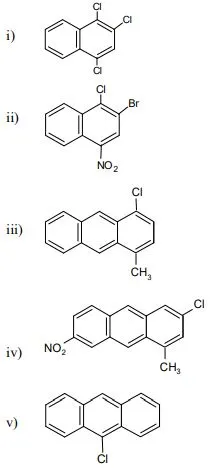
13. Give IUPAC name of the following compounds:
14. (i) The attack of the electrophile in furan occurs at the C-2 (or α) position. Explain with the help of a suitable example.
(ii) Write the preparation of pyridine.

15. Give the schematic diagram of the order of molecular orbital energies and give the possible electronic transitions in them.

16. Explain bathochromic shift with a suitable example.

17. Explain the electronic spectra of the acetylenic and benzenoid chromophore.

18. Explain the degrees of freedom for polyatomic molecules.

19. i) List different factors which govern the position and intensity of bands appearing in the IR spectrum of an organic compound.
ii) The C–C stretching vibration is infrared inactive (or nearly inactive). Give reason. In which region, C–H stretching absorptions of alkanes are exhibited?

20. Give the characteristics bands observed in the IR spectra of carboxylic acids and carboxylic acid anhydrides.

BCHET-147 Assignments Details

University : IGNOU (Indira Gandhi National Open University)
Title :Organometallics, Bioinorganic Chemistry, Polynuclear Hyderocarbons and UV, IR Spectroscopy
Language(s) : English
Code : BCHET-147
Degree :
Subject : Chemistry
Course : Discipline Specific Electives (DSE)
Author : Gullybaba.com Panel
Publisher : Gullybaba Publishing House Pvt. Ltd.
Help
Back to Top $

My Cart

[last_viewed_products limit="4"]

AI Sample Paper

Loading...