


 Help?
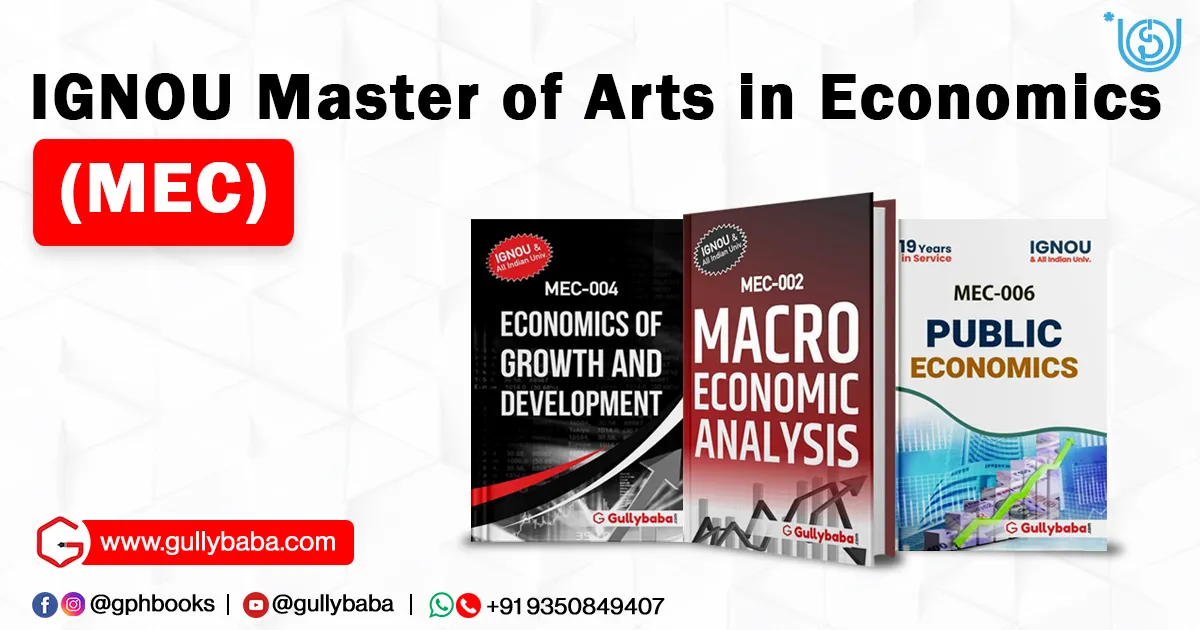
Help?IGNOU’s Master of Arts in Economics (MEC) programme gives students the chance to pursue Economics at a more advanced level. Along with the core courses taught by other universities, it also covers topics in the emerging fields of economics, such as insurance, finance, and public policy, that are likely to be beneficial given the current liberalization and globalization of the economy. Further, IGNOU’s Master of Arts in Economics (MEC) course gives students the opportunity for interdisciplinary studies such as Public Policy and E-Governance.
IGNOU’s Master of Arts in Economics (MEC) – Programme Guide
Eligibility Criteria
- As part of IGNOU’s commitment to ensuring both 'openness' and 'flexibility', students with a Bachelor's degree from a recognized university, regardless of their major, including those without graduate-level economics training are considered eligible for Masters of Art in Economics (MEC).
- Admission to the program does not require an entrance test.
- Applicants of any age can apply.
- There are some courses that require a certain level of mathematical understanding, in particular calculus and linear algebra. As such, students should be proficient in the basic mathematics covered at the +2 level.
- Academic programmes at IGNOU do not recognize master's degrees awarded without a first degree.
Duration
- Minimum Duration - 2 years
- Maximum Duration - 5 years
Medium of Instruction
IGNOU's MEC courses are available in both English and Hindi. Students applying for admission into the programme must select a medium of study.
Credit System
Several of the University's programs, including MEC, use the credit system. IGNOU's credit system for MEC equates one credit to 30 hours of student study (reading and understanding print materials, listening to audio-based materials, watching video-based materials, attending counselling, teleconferencing, and writing assignments). Students must complete 66 credits to earn the MA (Economics) degree.
The Structure
There are 66 Credits across 11 Courses in the Programme. There are nine mandatory courses and two optional courses. During the first year, five courses are compulsory. Second-year students must complete four compulsory courses and two optional ones.
Below is the list of courses taught in IGNOU's Master of Art in Economics (MEC):
| S.No. | Course Code | Course Title | Course Type | Credits | Blocks |
| First Year Courses |
| 1. | MEC-101 | Microeconomic Analysis | Compulsory | 6 | 7 |
| 2. | MEC-102 | Microeconomic Analysis | Compulsory | 6 | 7 |
| 3. | MEC-103 | Quantitative Methods for Economic Analysis | Compulsory | 6 | 6 |
| 4. | MEC-104 | Economic Growth and Development | Compulsory | 6 | 6 |
| 5. | MEC-105 | Indian Economic Policy | Compulsory | 6 | 6 |
| Second Year Courses |
| 6. | MEC-006 | Public Economics | Compulsory | 6 | 5 |
| 7. | MEC-007 | International Trade and Finance | Compulsory | 6 | 6 |
| 8. | MEC-108 | Economics of Social Sector and Environment | Compulsory | 6 | 6 |
| 9. | MEC-109 | Research Methods in Economy | Compulsory | 6 | 5 |
| 10. | MECE-001 | Economic Methods | Optional | 6 | 5 |
| 11. | MECE-003 | Actuarial Economics: Theory and Practice | Optional | 6 | 7 |
| 12. | MECE-004 | Financial Institutes and Markets | Optional | 6 | 5 |
| 13. | MECP-101 | Project Work | Optional | 6 | Project Guide |
| 14. | MGSE-009 | Gender Issues in Work Employment and Productivity | Optional | 4 | 3 |
| 15. | MWG-011 | Women in the Economy | Optional | 8 | 6 |
| 16. | MEDSE-046 | Development Issues and Prospectives | Optional | 6 | 5 |
MECE-001: Econometric Methods and MECE-003: Actuarial Economics: Theory and Practice are both quite mathematically oriented. MWG-11: Women in the Economy, and MGSE-009: Gender Issues in Work, Employment, and Productivity will need to be taken together.
Note: Students can also access the Student Handbook and Prospectus through the university's website, http://www.ignou.ac.in/.
Disclaimer: The information provided here is not comprehensive and should not be taken as such. Accordingly, this article may not list some courses. Students should contact the university if they have any questions about a course.
Search Articles
Categories
Latest Articles

IGNOU Solved Assignment 2025-26/2026-27 Free PDF Download
10 Apr, 2026
 gullybaba.com
If you are an IGNOU student, you already know one thing: 👉 Assignments are not optional they are compulsory. In Indira Gandhi National Open University (IGNOU), assignments carry significant weightage and can directly impact your final result. In this complete guide, you’ll learn: What IGNOU assignments are Why solved assignments are important Handwritten vs PDF […]
Read More
IGNOU Internship Program Details – Step by Step Guide
19 Mar, 2026
gullybaba.comMany IGNOU courses require students to complete an internship or project work before final submission. This internship is an important part of the course because marks are given based on the internship file, report, and submission at the study centre or regional centre. Students often get confused about the internship process, required documents, file format, […]
Read More
How to Write IGNOU Assignment 2026 – Step-by Step Writing Guide, Format & Submission Process
23 Feb, 2026
gullybaba.comIGNOU assignments are a compulsory part of every programme. Whether you are enrolled in BA, BCOM, BSC, BCA, MA, MCOM or any other course, submitting assignments correctly is essential to appear in the Term-End Examination (TEE). This complete guide explains everything clearly from writing format to submission process and common mistakes to avoid. IGNOU assignments […]
Read MoreIGNOU BA Books & Assignment 2026 – Complete Guide for Study Material and Solved Assignments
23 Feb, 2026
gullybaba.comIGNOU Bachelor of Arts (BA / BAM / BAG) is one of the most popular graduation programmes in India. Due to its flexible structure, lakhs of students enroll every year and look for clear guidance regarding books, study material, and assignment preparation. If you are enrolled in IGNOU BA or planning to take admission, this […]
Read MoreIGNOU Assignments: Complete Guide for Writing, Submission & Easy Solutions
19 Feb, 2026
gullybaba.comIGNOU assignments har student ke liye important hote hain, lekin maximum confusion bhi yahin hota hai. Bahut students poochte hain, IGNOU assignment kaise banaye, assignment format kya hota hai, handwritten ya typed submit karna chahiye, marks kaise milte hain, aur last date miss ho gayi to kya hoga. Agar aap bhi inhi questions se confused […]
Read More
Fraud Alert: Beware of Online Scams Misusing the Name of Gullybaba
02 Feb, 2026
gullybaba.comIn today’s digital world, online frauds are increasing rapidly. Unfortunately, even trusted and well-known brands are sometimes misused by fraudsters to cheat innocent people. we believe in transparency and responsibility towards our students, readers, and professional community. This blog is written to create awareness, protect users, and guide anyone who may be affected by such […]
Read More
