

 Help?
Help?
PLEASE MATCH YOUR ASSIGNMENT QUESTIONS ACCORDING TO YOUR SESSION
IGNOU BPHCT-135 (January 2026 – December 2026) Assignment Questions

2. a) A mass of an ideal gas ( 1.5) at 27C is suddenly compressed to four times its original pressure. Calculate the final temperature of the gas. (
b) i) What are intensive and extensive variables for thermodynamic systems? Write two examples of each.
ii) Represent an (a) isobaric (b) isochoric (c) isothermal and (d) a cyclic process on p-V indicator diagram.
c) State the zeroth law of thermodynamics. Explain how the zeroth law introduces the concept of temperature.
d) Obtain the expressions of work done for an ideal gas (i) in an isothermal expansion (ii)) in an adiabatic process.
e) Obtain an expression of coefficient of volume expansion for one mole of van der Waals’ gas.
PART B
3. a) Consider that two ideal gases having n1 moles are n2 moles are enclosed in two separate containers at constant temperate T and pressure P. It these two gases mix, obtain an expression for the entropy of mixing per mole of mixture.
b) Draw p-V diagram of the Carnot Cycle and hence obtain an expression of efficiency.
c) Using the Maxwell’s relations of thermodynamics, obtain the first and second TdSequations.
d) Derive Clausius-Clayperon equation of phase transition. Draw phase diagram of water.
e) What is Joule-Thomson effect? Write any four findings of Joule- Thomson experiment.
4. a) Derive an expression of the partition function for a single particle monatomic ideal gas. Write the expression for a monatomic gas consisting of N-identical yet distinguishable and non-interacting particles.

IGNOU BPHCT-135 (January 2025 – December 2025) Assignment Questions
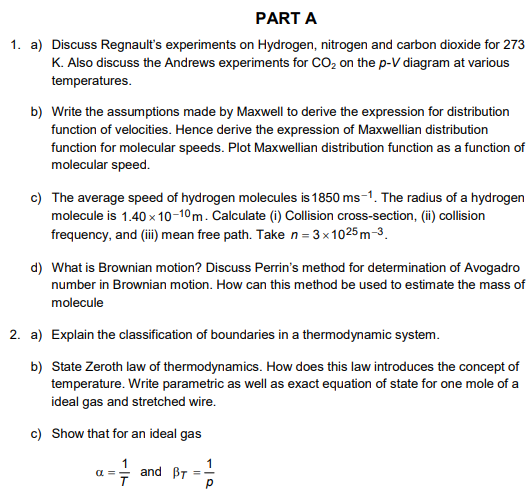
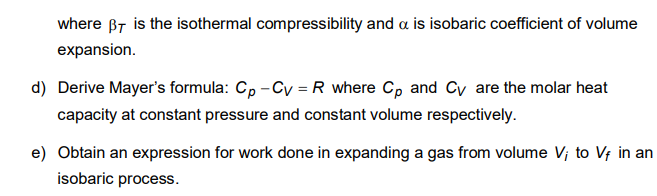
PART B
3. a) With the help of entropy – temperature diagram of Carnot cycle, obtain an expression of efficiency of a Carnot engine. A Carnot engine has an efficiency of 50%. It operates between reservoirs of constant temperature with temperature difference of 80 K. Calculate the temperature of the low-temperature reservoir in Celsius.
b) Define thermodynamic potentials. Derive Maxwell’s relations from thermodynamic
potentials.
c) When two phases of a substance coexist in equilibrium at constant temperature and pressure, their specific Gibb’s free energies are equal. Using this fact, obtain Clausius-Clapeyron equation.
d) Derive Planck’s law of radiation and hence obtain Rayleigh-Jeans law and Wien’s law.
4. a) Consider a classical ideal gas consisting of N particles. The energy of a particle is given by cp where c is a constant and p is the magnitude of the momentum. Calculate (i) the partition function of the system, (ii) internal energy, and (iii) CV.
b) 21 5.4 10 electrons are confined in a box of volume 3 1cm. Calculate their Fermi wavelength and Fermi energy.
c) Define thermodynamic probability of a macrostate. Establish the Boltzmann relation between entropy and thermodynamic probability:
S kB lnW.
d) Obtain an expression of Fermi-Dirac distribution function. Plot Fermi function versus energy at different temperatures.