IGNOU BCHCT-131 (January 2026 – December 2026) Assignment Questions
1. Explain Geiger and Marsden’s a-particle experiment using a suitable diagram
2. (a) Name different lines exhibited in the atomic spectrum of hydrogen.
(b) Write the de-Brogile relationship for dual nature of matter. Also define matter waves.
3. Briefly discuss photoelectric effect. Also give the explanation of this effect given by Einstein.
4. (a) List the applications of Schrodinger equation.

5. What are four quantum numbers? Give their significance.
6. (a) Explain the stability of half-filled and completely filled orbitals giving suitable examples.
(b) Give any two examples of atoms showing anomalous electronic configurations.
7. State and illustrate Fajan’s rules giving suitable examples.
8. (a) What is electronegativity? Arrange the following in the decreasing order of their electronegativities: K, F and I
(b) Compare the characteristics of ionic and covalent compounds.
9. (a) Write the resonance structures of dimethylsulphone.
(b) Give the type of hybridisation in the following molecules:

10 (a) Draw py-py combination of atomic orbitals to give the suitable molecular orbitals.
(b) Calculate the bond order of F2 molecule from its molecular orbital configuration.
PART-(B)

(b) How will you distinguish maleic acid and fumaric acid?

(b) Give example of a meso compound. Also comment on its optical activity giving reason.
13. Draw the energy profile for various confirmations exhibited by cyclohexane. Also explain the relative energies of various conformations.
14. Explain the relative stability of the following carbocations:
(i) methyl carbocation
(ii) a tertiary carbocation
(iii) a primary carbocation
(iv) a secondary carbocation
15. (a) Differentiate between the basicity and nucleophilicity giving suitable examples
(b) Briefly explain the mechanism of β-elimination,
16. (a) Briefly explain Kolbe’s electrolytic method for the synthesis of alkanes.
(b) What is aromatisation of gasoline? Illustrate giving appropriate reactions.
17. State and explain Saytzeff rule giving a suitable example.
18. Explain retro Diels-Alder reaction giving a suitable example.
19. (a) (i) State Markowinkoff’s Rule.
(ii) What is peroxide effect? Explain.
(b) Write the reactions for the hydroboration of propene followed by the oxidation by alkaline H2O2.
20. (a) How will you prepare 3-octyne from 1-hexyne? Write the steps involved.
(b) Write the products of oxidation of 2-hexyne using alkaline KMnO4.
IGNOU BCHCT-131 (January 2025 – December 2025) Assignment Questions
PART-(A)
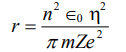
1. How is the following expression for radius of hydrogen atom arrived at?
2. (a) Briefly explain Heisenberg uncertainty principle.
(b) Name the phenomena which can be explained using
(i) wave nature of radiation
(ii) particle nature of radiation.
3. Arrive at the time independent Schrodinger equation for a particle.
4. Explain the transformation of Schrodinger equation from Cartesian to spherical polar coordinates and give its solution.
5. (a) Write the electronic configuration of the following:
Cl, Cr, Nb
(b) State aufbau principle.
6. First ionisation energies of second period elements show that the values increase from lithium to beryllium, decrease for boron, and increase up to nitrogen, again decrease in oxygen and finally increase up to neon. Explain.
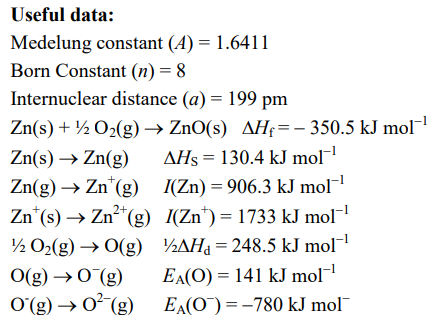
7. Calculate the lattice energy (in Units kJ mol1) for ZnO crystal using electrostatic model and using a Born-Haber cycle. Compare the two answers and comment on any difference.
8. a) i) Define formal charge. State the purpose of calculating formal charge of a molecule and write its assumptions.
ii) Calculate the formal charges of NH3 and NH4+.
b) Predict the molecular geometry of XeF4 and PCl5 molecules by using VSEPR theory.
9. Draw the resonance structures of HCl. Out of them which one has little importance as a resonance structure and why?
10. Write the molecular orbital configurations of O2and- O2. Calculate their bond orders and comment on their magnetic nature.
PART-(B)
11. a) Write the chain isomers for a molecule having molecular formula C5H12.
b) Write the geometrical isomers of 1,2-dimethylcyclopropane. Which one of them will have a dipole moment and why?
12. Write the Fischer projections of stereoisomers of 2,3,4-trihydroxybutanal. Classify as them as erythrose or threose type. Also mark their configuration as D or L.
13. Draw and explain various confirmations of butane. Which one of them is least stable and which one is the most stable?
14. a) Write the resonance structures of ethanoate ion. Is the negative charge localised or not?
b) Illustrate hyper conjugation with a suitable example.
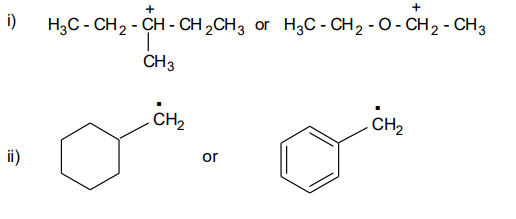
15. a) How does the stabilities of free radicals resemble those of carbocations? Explain with the help of suitable examples
b) Which out of the following pairs is more stable and why?
16. Briefly explain the following reactions and give their importance;
(i) Wurtz reaction
(ii) Sabatier-Senderen’s reaction
17. Explain the mechanism of Birch reduction giving a suitable example.
18. Write the mechanism of hydration of 1-butene.
19. Write the products formed when 2-pentyne undergoes ozonolysis. Give the mechanism involved.
20. Draw the molecular orbitals of benzene and illustrate its electronic configuration.



 Help?
Help?